
Categories
Value at the Bench

Value at the bench
Cost vs. Value, in perspective
People tell us JURA tools are expensive. This is the short journey that shows the opposite.
The story
Fifty stones a day
When Jura started out, there were no efficient tools to buy — nothing built for how the work is really done. His first job was French cut micro bands for a leading jewellery house, at fifty stones a day. Not closing prongs on ready-made seats — setting from scratch, every seat drilled and cut, girdle to girdle. Fifty done properly is still an honest day’s work today.
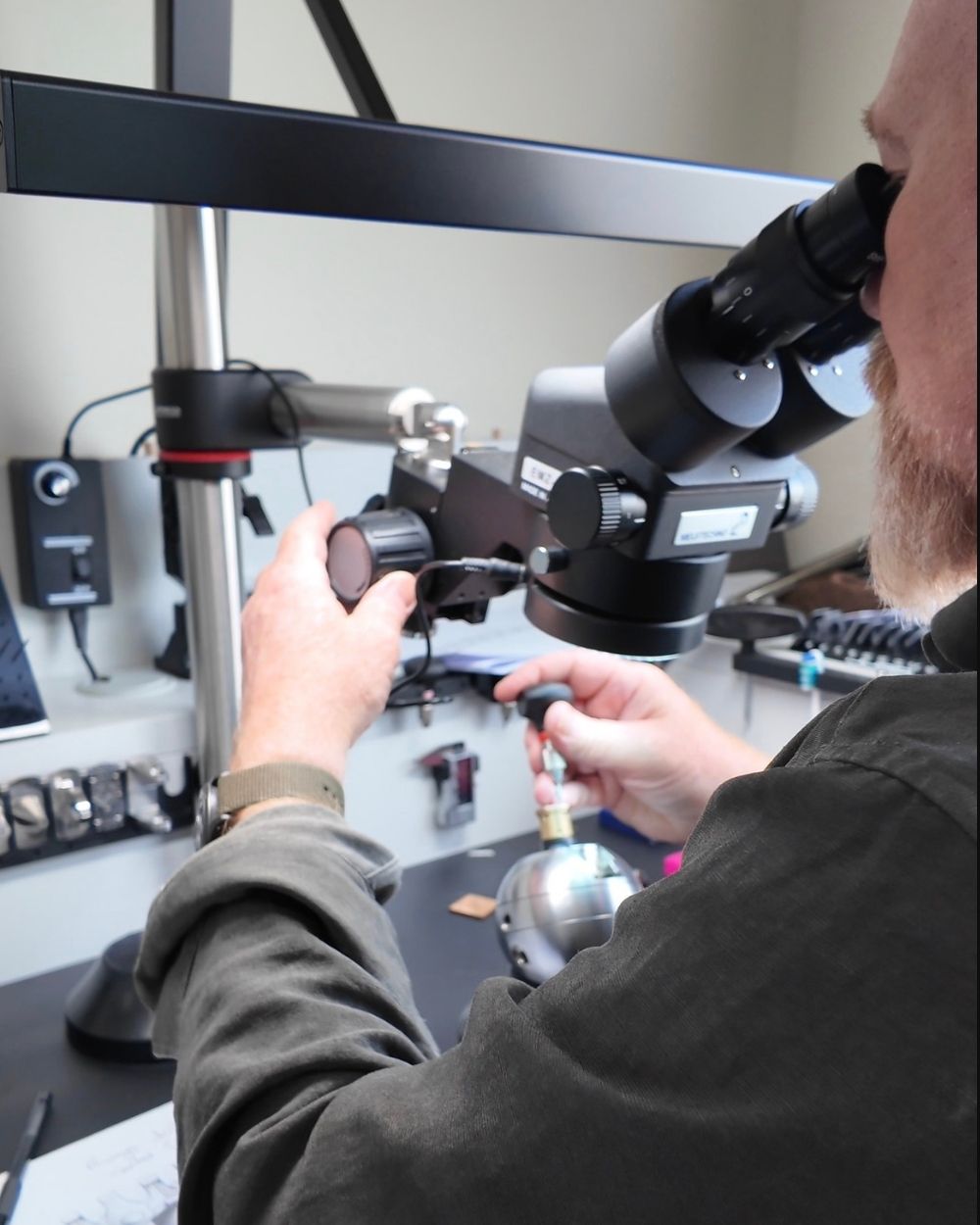
It bothered him from the first day: tools that fought the hand. So he built his own — and was soon setting three hundred a day, six times the work, at a quality that spoke for itself. When his employer tried to pay him less per stone, he closed the door behind him and never came back.
Jura knew his worth from day one — and every master should.
He would not let anyone price his work below what it was worth. That is where these tools come from, and why this page exists.


Charles Mingus — the line Jura chose for himself
The family
A worldwide standard, kept small on purpose
He never advertised. Setters found him bench to bench, and in 2000 that became a company, in 2003 a school, because people kept asking to be taught. The way he works is now a worldwide standard, and it is still the same family: Jura engineers the tools, his daughter runs the company, her husband teaches, and a granddaughter is the third generation. We have never tried to grow big. We keep the teaching small on purpose, in two established training centres — quality over quantity, and small enough to stay personal. The people we teach become part of the JURA family, an international community of like-minded, ambitious masters that now reaches every corner of the world, and they can keep asking us questions for the rest of their working lives.
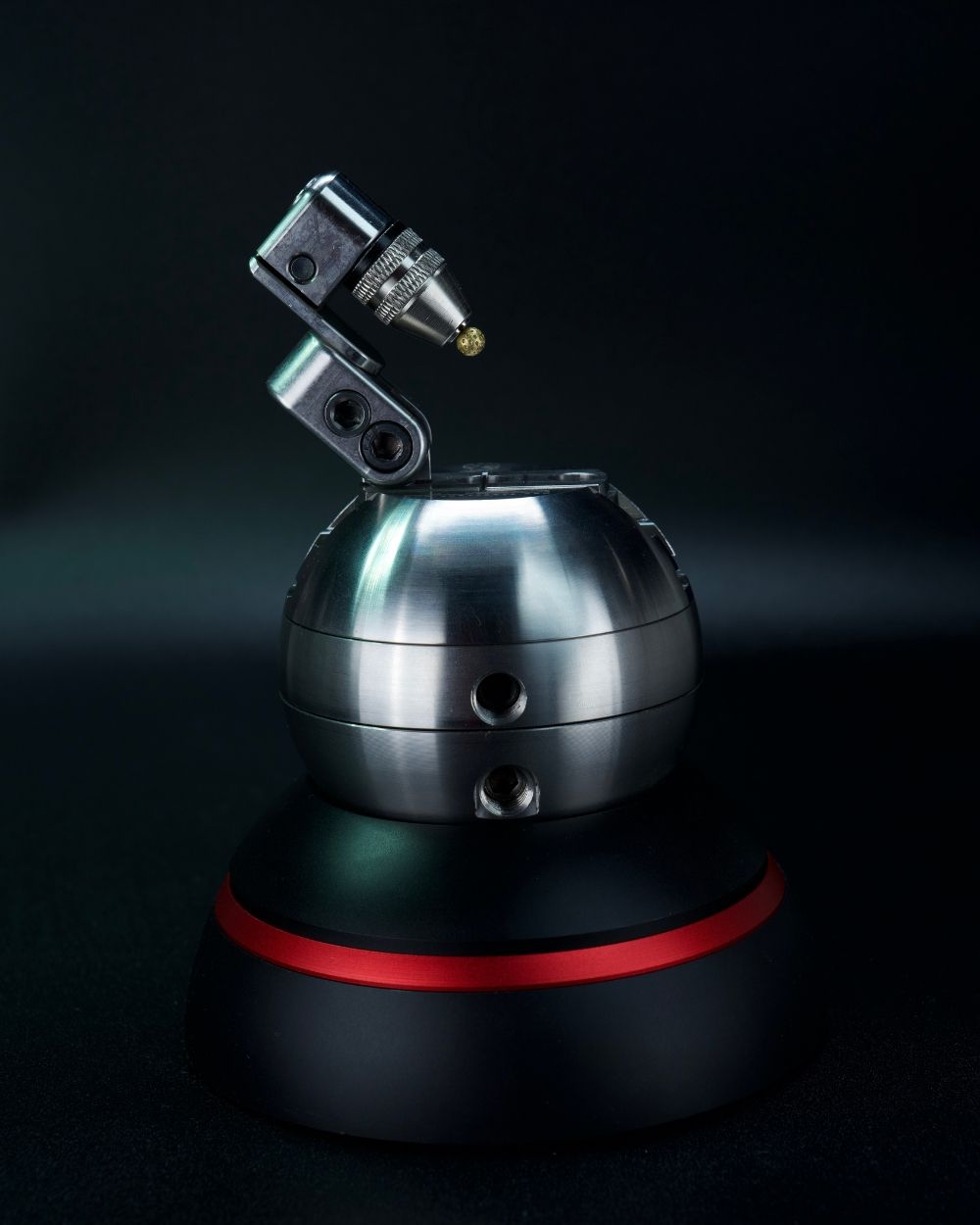
The technique, the tools, the bench, the machine — invented, made and taught in-house. From zero to master, from our bench to yours, with no middleman between you and the person who invented it.
The standard
Sophistication is the standard, not a luxury
Jura was a musician before he was a setter, and it shows in the design: a tool should disappear in the hand. Every detail has a purpose — we can give the reason behind each one, and teach the setter how to use it to their benefit — and anything that is not functional is left out. A tool should also be beautiful, because a setter spends more of their life at this bench than almost anywhere. It is also how an artist respects himself: he works this way because he wants the work valued, and the customer feels that. So we never make a cheaper version; if something cannot be done properly, we leave it out. Quality without compromise is the rule. Preparation is ninety percent of the work, and speed is never chased — it is simply what happens when the bench is clean, ergonomic and calm.
We don’t follow the market or trade in tools; we solve problems. A difficulty appears at the bench, the answer becomes a tool that did not exist before — and we teach setters to use it. We set the standard, and so do the setters who work with us.
“Every detail must have a reason. If not, it’s wasted energy.” — Jura
The picture
From a living to a comfortable bench
An employee’s wage quietly includes paid holidays, pension and insurance. A self-employed setter has none of that built in and must not forget it: pension, liability and business insurance, the workshop and the materials, and the roughly one day in four spent away from the bench — quoting, packing, shipping, talking to customers — all come out of their own invoices. So just to take home an ordinary living — around €48,000 — a self-employed setter has to invoice a good deal more once those hidden costs are covered.
| What a bench brings in | Invoiced
a year |
Net
a year* |
Net
a month* |
|---|---|---|---|
| An ordinary living — the start | €72,000 | €48,000 | ≈ €4,000 |
| A comfortable, established bench | €100,000 | ≈ €67,000 | ≈ €5,600 |
| A successful bench | €120,000 | ≈ €80,000 | ≈ €6,700 |
*Net is what is left after business costs (insurance, pension, workshop, materials, the non-billable time) — before personal income tax, which varies from country to country. Take-home runs around two-thirds of what is invoiced.
That ordinary living is only the starting point, not the goal. A setter carries the same costs as everyone else — a home, a family, a future — and pays the same prices everyone pays. The very garage that charges around €120 an hour to work on a car — and €150 to €200 at the top in some countries — sends the setter that same bill. So the income to aim for is a comfortable one: enough to live well, to afford the life around the bench, and to feel, rightly, successful.
The real question is never the floor. It is the climb — from a bare living toward a comfortable, thriving bench.
And that climb is exactly what the bench decides. Good tools and a good method are what carry a setter upward: more work in the same hour, cleaner results, a hand that lasts, and the higher-value work that follows.
Hold your ground
Never chase work by dropping your price
The temptation is always there — charge a little less, win the job. But a price is the hardest thing to undo: once it is set low, it is hard to raise. Undercut yourself and you tell the customer your own work is worth less — and you pull the whole trade down with you.
What a setter can ask is never one fixed figure. It depends on the level of the work, on the market and the region — and above all on skill. The finer and more certain the hand, the more the work is worth. A price is also how a master respects himself: set it to reflect the standard you hold, and the customer feels it.
True mastery is the one thing that should never be discounted. Hold your price, and let the work prove it.
The investment
What the tools cost — and give back
Here is the shift that changes everything: a JURA tool is not a cost carried — it is what it gives back. Nothing needs buying all at once; a setter adds one piece at a time. Written down, the prices can look like a lot. Measured against what they give back, they do not.
So how much do they give back? Jura’s own bench went six times faster — five hundred percent — but that was one man on his own invention, no basis for a promise. Setters who come to these tools report up to fifty percent more productivity, easily. We set all of that aside and take a deliberately cautious twenty percent — the very least a willing setter gains — so no one can wave the numbers away. Twenty percent, and more, is very manageable for anyone who wants to grow.
And it does not come from thin air: twenty percent is pure efficiency — a cleaner, unobstructed workflow, no wasted steps, tools that work with the setter instead of against, so more gets done in the same hour.
And that is only the efficiency. There is far more to gain: health and time, the joy of the work and less stress, growing skills and customers who take the work seriously, a stronger career and the recognition the craft deserves.
| Tool | Price (excl. VAT) | Earns its cost back in* |
|---|---|---|
| Eccentric Basic Set | €793 | 2 to 3 weeks |
| 3X MAX Starter Set | €1,418 | 3 to 6 weeks |
| JURA Graver Plus | €4,150 | 2 to 4 months |
*Perspective, at a cautious twenty percent: the payback comes sooner as output climbs. After that it is pure gain — at least €14,000 a year, for as long as the work continues.
| Efficiency reached | Extra turnover a year* |
|---|---|
| +10% | €7,000 to €12,000 |
| +20% — the cautious figure | €14,000 to €24,000 |
| +30% | €22,000 to €36,000 |
A cautious twenty percent is €14,000 to €24,000 more a year for a working bench — and it keeps coming once the tools are paid off.
How much a setter gains depends on where they start. From old-fashioned tools the leap is large. But even from a well-equipped modern bench the gain is real — at least that cautious twenty percent — because efficiency is what we design for first: the whole way the bench works together, from how a setter sits to how they hold and change over. Jura keeps improving the tools too, so there is always a real step from one JURA generation to the next. We grow with every step.
It is an eye-opener, not a promise: the tool opens the door, the setter walks through it.
Our tools do not fix shortcomings — they open opportunities for those who truly want to make a difference.
Our vision is not to sell equipment, but to take a committed craftsman to the next level, the way a teacher does. We are not for everyone — we are for the ones who want to grow, and who share a vision of excellence.
JURA
More than money
Time, health, and the freedom to choose
Everything so far has measured a setter against an ordinary nine-to-five income — a fair yardstick, but only a yardstick. No real setter has a nine-to-five mentality. This is an artist’s craft, done with love, at hours an ordinary worker could not imagine. So efficiency is not about clocking off early; it is about freedom — to earn what the craft deserves, or to take time back at will.
The same cautious twenty percent can be spent two ways:
| A cautious 20% gain | What it is worth |
|---|---|
| Taken as money | ≈ €14,000 more a year |
| Taken as time | ≈ 37 fewer working days |
Around thirty-seven working days a year — the best part of two months — free to spend as the setter wishes.
Then there is health. A bench at the right height, with holding that does the gripping, spares the hands and back over a career; proper extraction keeps dust and fumes out of the lungs. Fewer physical problems, fewer doctor’s bills, more good years at the work.
And whatever is not taken is lost: every year at a slow bench is work that never happens — money left on the bench that never reaches an invoice.
The whole chain
One system, made to last
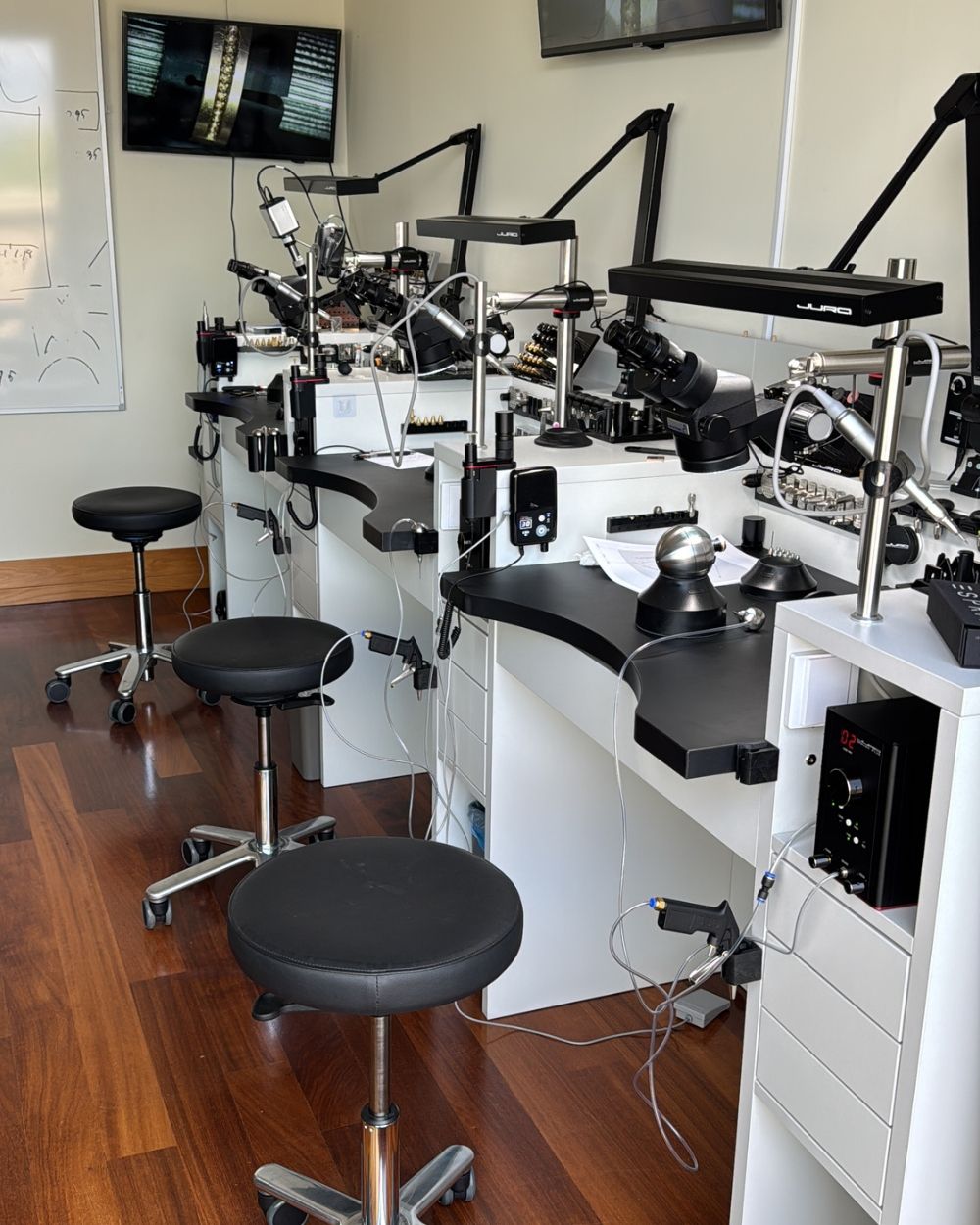
Every JURA tool began as a real problem at our own bench — solved, tested in our classroom, then made to order in-house. Buying one is not buying an object; it is buying into the whole chain, and the family behind it.
It is one system, made to last: real, enduring quality — compatible, interchangeable and expandable, and built to grow with the setter. The clamp bought now still fits the vise added in three years; nothing invested in becomes a dead end. That is why the cheapest tool is so often the expensive one.
What we solve is simple: the bench that fights the hand, the hours lost to clumsy change-overs, the strain that ends careers, and the fine work that has had to be turned away.
A clean, organised, sophisticated bench does something quiet but powerful: before a word is said, it tells a customer their stones are in careful hands — and that wins high-end work.
| What it gives now | What it gives over a career |
|---|---|
| More work in the same hour | A skill that keeps growing |
| Less strain, cleaner results | Higher-value work to say yes to |
| Tools that pay back in weeks to months | A hand — and a career — that lasts |
The JURA promise
Not a tool. A future.
A JURA tool does not just solve today’s problem — it opens a world of opportunities. We listen to the setters who use our tools, solve the problems they bring us, and design ahead for the work still to come. Every purchase keeps the workshop inventing, so the next solution reaches the bench too. What a setter invests in us, we invest back in them.
Seen this way, a JURA tool is never a cost carried but a gain: more work, more skill, and a setter’s growth as a master. The gain only ever comes from what is invested in.
Our promise is not a number. It is to keep solving the problems at the bench, and to keep bringing you the next tool, the next solution, the next door to walk through.
One lesson from one generation to the next


it is never enough. Never give up what matters most for the sake of one more stone.
— Xenia
One point of contact
Every JURA tool is developed, built, serviced and used by us — at our own bench, every day. We know each one in detail, from the feel of its vibration to its sound. This means one point of contact and short lines: direct contact with the people who make them. As a family company, we stand behind our product.
Figures are a true-to-market picture; incomes, taxes and rates vary from country to country. The income levels and the twenty percent are rough references for perspective — an eye-opener, not a claim, guarantee, or promise of results, which always depend on the setter and the level of the work. Tool prices from juratools.com, excl. VAT (reclaimable for a registered business — a question for an accountant).
Display prices in:EUR
